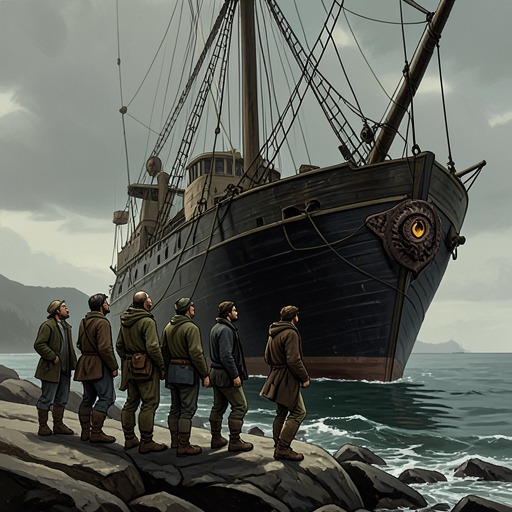
Vickon Greyjoy
Fire & BloodVickon Greyjoy was chosen by the ironborn as their lord paramount after Aegon Targaryen intervened in the Iron Islands’ succession conflict. His accession joined local choice to submission to the Crown: he did homage to the king, but his writ was limited to the islands and did not extend over House Hoare’s former mainland conquests.
The Succession Conflict
For more than a year, competing claimants and their adherents had fought across the Iron Islands, by land and sea. On Old Wyk, priests of the Drowned God crowned the barefoot holy man Lodos, who proclaimed himself the god’s living son; other claimants arose on Great Wyk, Pyke, and Orkmont. The fighting was so bloody that stories told of waters choked with corpses and krakens drawn by the blood.
In 2 AC, Aegon Targaryen ended the conflict by descending on the islands on Balerion, accompanied by fleets from the Arbor, Highgarden, and Lannisport, as well as longships sent from Bear Island by Torrhen Stark. The ironborn, depleted by their internecine war, offered little resistance, and many welcomed the dragons. Aegon killed Qhorin Volmark with Blackfyre but allowed Qhorin’s infant son to inherit his lands and castle. Lodos’s appeal to the krakens failed; he walked into the sea with stones in his robes, and thousands followed him. Their bodies continued to wash ashore on Old Wyk for years. Vickon’s selection came after this intervention; the account does not identify him as one of the wartime claimants.
Chosen Lord of the Iron Islands
Once the fighting had ended, the question was how the islands should be governed on the king’s behalf. Proposals included making the ironborn vassals of the Tullys of Riverrun, the Lannisters of Casterly Rock, or the rulers at Winterfell. Aegon heard the competing claims but chose to let the islanders select their own lord paramount. They chose Vickon, already identified as Lord Reaper of Pyke, a choice described as unsurprising because he was one of their own.
The arrangement gave Vickon authority through the ironborn’s own decision, while placing that authority within the new royal order. He did homage to Aegon, and the king departed with his fleets. The settlement thus relied on both local recognition and formal allegiance to the conqueror, rather than assigning the islands outright to a mainland lord.
Limits of His Rule
Vickon’s writ extended only to the Iron Islands. He renounced any claim to the mainland territories House Hoare had seized, leaving the islands’ new lord paramount distinct from the rulers of those lands. Aegon granted ruined Harrenhal and its domains to Quenton Qoherys, but required him to accept Edmyn Tully as his liege lord. The account presents that mainland settlement separately from Vickon’s island rule: Vickon’s authority did not restore the former reach of House Hoare.
With the submission of both the Three Sisters and the Iron Islands, Aegon ruled all of Westeros south of the Wall except Dorne. Vickon’s accession was therefore part of a wider consolidation, but one that preserved a measure of regional choice while clearly defining the boundary of his lordship.